
A pathbreaking, non-violent silk-making technique developed after three years of sustained R&D
Team News Riveting
February 1, 2026
‘Jeevodaya’, a unique and pathbreaking silk production pilot project of IIT Bombay, supported by Coal India under its Corporate Social Responsibility (CSR) initiative, has achieved a significant breakthrough after three years of continuous research and development.
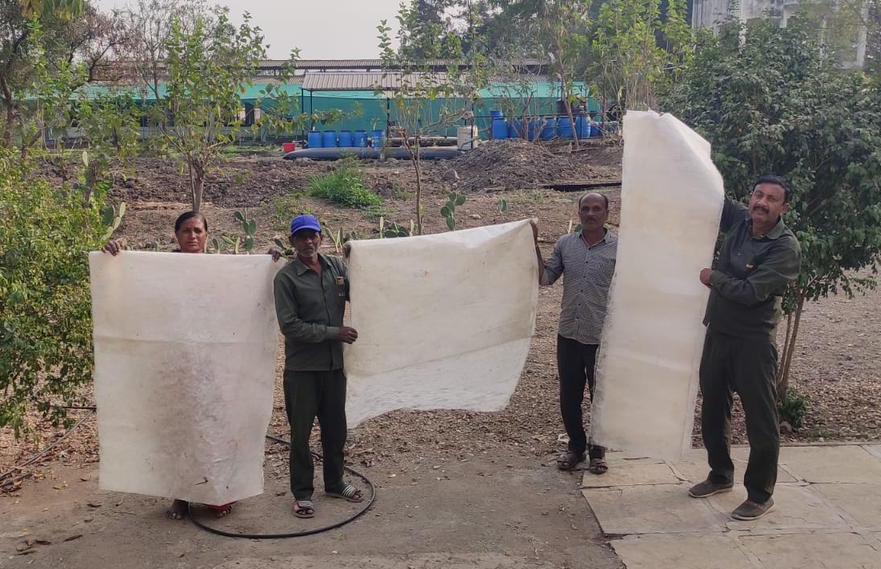
Under this project, IIT Bombay’s Centre for Technology Alternatives for Rural Areas (C-TARA) has successfully developed an innovative silk production technique that eliminates the need to kill silkworms. Unlike conventional practices, the new method allows silkworms to produce silk threads and subsequently transform into moths, enabling them to complete their natural life cycle. In keeping with its humane and ethical approach, the product has been aptly named ‘Jeevodaya Silk’.
Traditionally, silkworms feeding on mulberry leaves spin cocoons around themselves. To extract silk, these cocoons are boiled, resulting in the death of millions of silkworms. Challenging this long-standing practice, the Jeevodaya project has reimagined silk production through scientific innovation rooted in compassion.
After three years of tireless experimentation, C-TARA achieved a rare scientific milestone by successfully training silkworms to lay silk threads on a flat surface without forming cocoons. As a result, the worms are no longer required to build cocoons and are eventually able to emerge as moths and fly free. This breakthrough stands as a living embodiment of the ancient Indian ideal: “Mā kaścid duḥkhabhāg bhavet” — may no one suffer.
Coal India has played a pivotal role in nurturing this extraordinary experiment from concept to fruition through sustained CSR support. Beyond its ethical and environmental significance, the technology also opens up a new and sustainable source of income for farmers engaged in silk production, thereby strengthening rural livelihoods.
With the success of the Jeevodaya pilot, the project holds immense potential for wider adoption, and sustainable silk production.


